|
Introduction The Cricket Fiddle Logo The Shop Biological Survey
Current Catalog
|
Other Stuff:
(And "Miraculous Achievements" down below) An Odd
assortment of Strange and Obscure Instruments that may only find homes with Odd,
Strange and Obscure Eccentric People! YOU may be one of them. See what's
currently available down below....
___________________________________________________
Restored Grecian Pedal Harp
made by: Jacob Erat and Sons
London
A friend of mine bought this old Harp from a lady that said "Get that old piece
of furniture out of here!" When he brought it to me, the sound board had been
ripped up by a set of metal strings that
were installed ages ago. It appeared to have been seriously damaged for a very
long time!
I rebuilt the sound board and installed a complete set of Vanderbilt Classic
Natural Gut strings.
After I tightened the string pressure and tuned it up everything seemed
alright.
It looked and sounded good.
However...After a while I began to hear that sickening sound of wood
creaking and groaning. The soundboard still looked OK so I
wasn't really sure what was happening. After closer examination I soon realized
that the entire body was pulling up and away from the pedestal! I quickly
de-tuned the harp until there was almost no string pressure remaining...but too
late. The damage had been done (Again!) I informed the owner that the poor old
Harp had indeed passed away (again) and that it might possibly be restored
enough to be a museum piece or at the very least, a theatre stage prop. Sad to
say...It would Never be
playable again. (There was even a brief thought that it would be fed into the
fireplace!!!)

What caused the problem This time was the fact that a couple thousand
pounds of string pressure was being held together by nothing more than 4 old
wooden dowel rods and a thin layer of ancient crystallized glue. This was kind
of like expecting a 95 year old man to bench press a thousand pounds up over his
head! The poor old dried out bones just couldn't take it.
I had put in so much time on this project that I tried again and with a
great deal of difficulty I managed to get the body back into the original
grooves of the pedestal and heavily reinforced it with metal brackets. I then
tuned it up only as far as to keep the pillar on the pedestal and That is as far
as I will ever go with! There may be a possibility that this old Harp might yet
be able to be tuned up to full string pressure and played...but I would Heavily
recommend that the poor old thing be permanently retired from performing and
simply be allowed to stand at attention and look good. (It really does look
good!)

So...the question is: Would anyone like to have a nice old and rare collectible
in their home? All the time I was doing research on the the origins of this
thing I mistakenly believed the carved inscription to read:
"J. Prat and Sons".
Of course I could find no information with that
name so I thought I hit a dead end...until I realized that the outrageously
intricately carved letters in the pin-block read:
"J. Erat and Sons..." !!! Then I began to find some information:
Apparently...Jacob Erat was a harp builder in London who died in 1821. His 2
sons took over the harp building business...so it would seem we have an original
built by the old man which would put the construction date at least before 1820!
The carved
inscription reads:
J. Erat and Sons Patent 23 Berners Street London 1499
This amazingly detailed carving of a Lion, a crown and a Unicorn is only about 2
inches across. The words in the top part read:
HONI SOIT QUI MAI.
The words in the banner on the bottom read:
DIEU ET MON DROIT.
I asked a friend of mine to translate and this is what he came up with:
The inscription in part is actually two, I perceive, and the 1st one
is French, early modern or late-mediaeval, take your pick.
Honi soit qui mal y pense:
'Shame to him who thinks it Evil.'
And the other also is the same, in French:
Dieu et mon droit:
'God and my right.'
As soon as we have an idea of its estimated value, an asking price will be
attached.
___________________________________________________
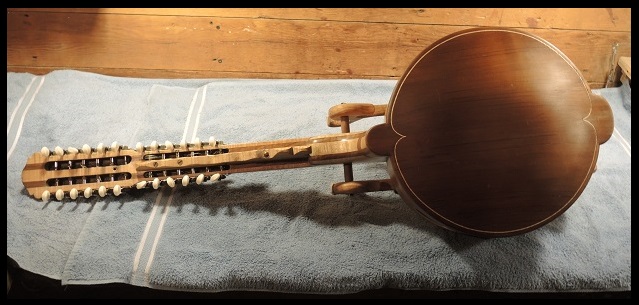
Here is a sketch of an African Gourd Harp or Kora.
This is an example of the original design from West
Africa. I modified the design a bit so that the poor Americans and other
"Westerners" would not have so much difficulty in tuning and maintenance. Here's
what I came up with:
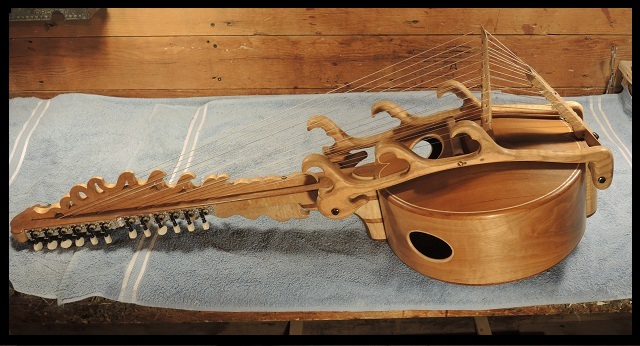
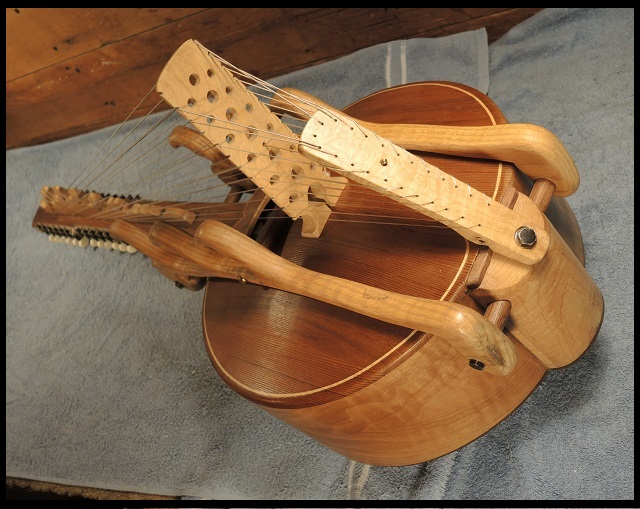
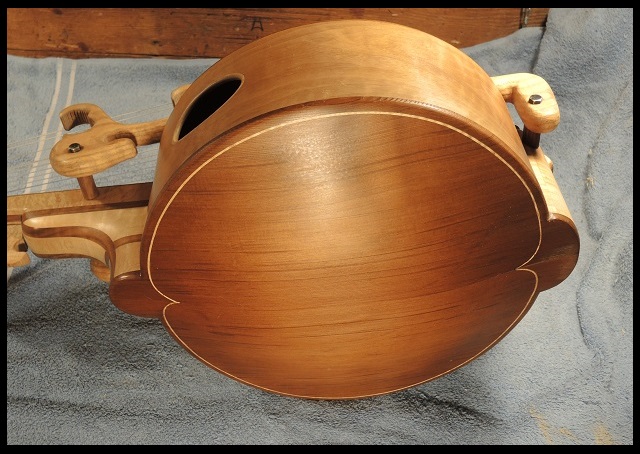
It is
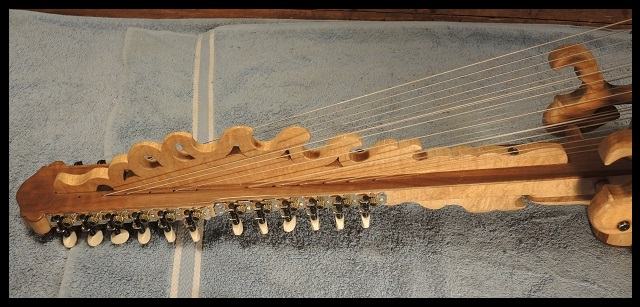
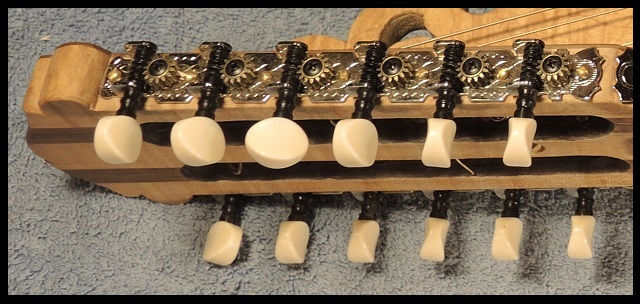
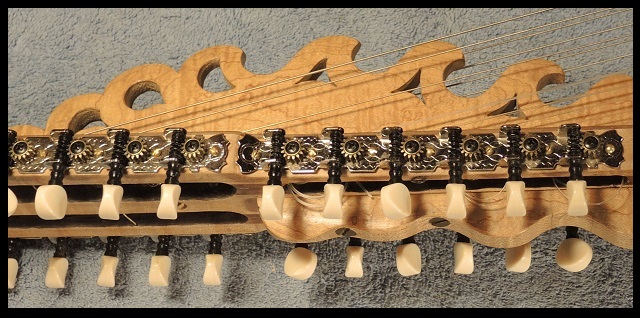
made entirely of wood with two sets of 12-String Guitar tuners.
The top,
traditionally made of cow hide, is made of carved western Cedar. The back and
sides, instead of a huge calabash gourd, is made of Cedar and highly figured
curly Walnut. The neck is made
from highly figured hard rock Maple. There is an intricately carved Maple brace
glued and bolted on between the 2 rows of strings. This is to help stabilize the
neck from the tremendous tension and pressure from the 26 strings...which
consist of 4 sets of classical guitar strings. The tuners are 2 sets of
12-string guitar tuners.
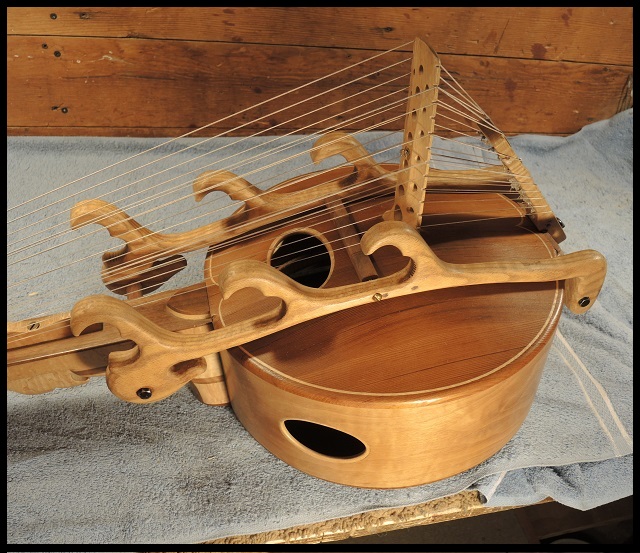
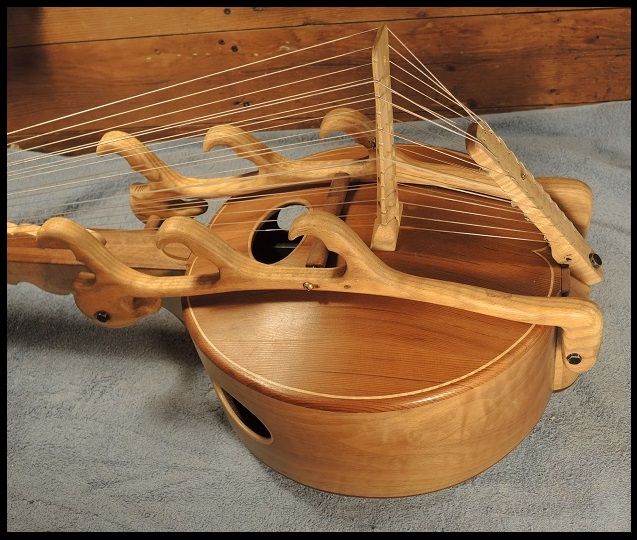
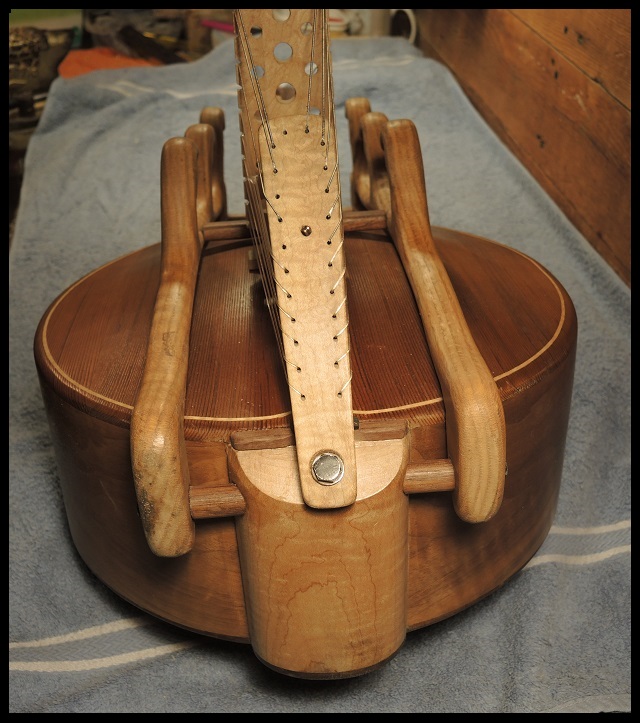
Here's a side
view. The handles (which I've been told look like Deer antlers...or a gun rack)
are made of curly Walnut. There are 3 different ways to hold this
thing...depending on how close you want your thumbs and fingers to be from the
bridge. You can get 3 different tones out of it: A sharper, clearer tone when
pickin closer to the bridge and a more mellow, muffled tone the farther away you
get from the bridge. (This is one of my innovations. Took forever to come up
with the final solution!)
The tall towering bridge
is held in place by a wire cable attached to the tailpiece. (Otherwise it would
just shoot off and slam down onto the soundboard) And the solution to the
tremendous
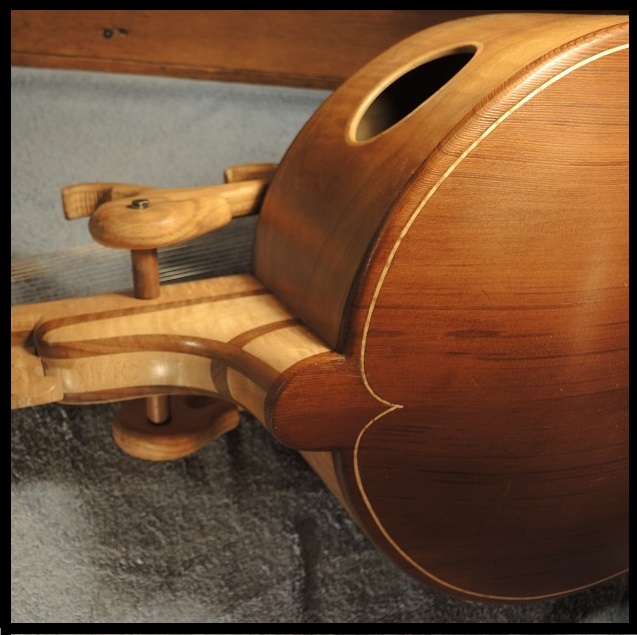
pressure exerted on the whole infra-structure (both from the top down
and the pull coming up from the neck) was solved by installing 2 steel
construction rods attached inside the neck and running right through the middle
of the body to the tail block ...basically the entire length of the instrument.
(Which can be seen from the sound hole) I made this thing in 2002. Actually...I
made 2 of them...but the first one didn't last long: I failed to calculate the
effects of string pressure on a
structure that Didn't originally have the steel
reinforcement rods put in. And so ...during the second afternoon of it's grand
debut at the 2002 Rock Bend Folk Festival (which as I recall hit a high temp of
92 degrees that day) we watched and listened as the poor thing gradually
imploded in on itself! After dis-mantling That one I made another and That one
has stabilized and has quite a nice tone...despite the fact that the soundboard
has settled right down onto the steel rods. (This is a Good thing!) Currently
for sale and available for public viewing at Groth Music, Bloomington, Minn. The future owner might consider having an
electronic pick-up installed at some time. This will be a cool addition to that
"NeoAfroRetroCelticHybrid" band you've been thinking of putting together!
There's Got to be someone out there that will get this thing up on stage and
bedazzle the audience with.
The KORA has just been sold!
(Thanks Mathew)
--------------------------------------------------------------------------------
Bowed Psaltery:
Here
is one of the Easiest stringed instruments in the world! You just pick
it up and bow each separate string...one at a time. Based on a simple ancient
design from the middle ages...the final triangular shaped form you see here was
actually 'invented' by a couple from Florida in the 1970's. (You may have seen
them at the Renaissance Festival.) I made about a
dozen of these back in the late 80's and early 90's. This one recently came back
to me so I shined it up a bit...made a better bow and a nice felt lined
case for it, too. There are 17 strings on the right (2 and a half
octaves
from 'F' to 'A') The 13 strings on the left are the sharp notes (like the
'black' keys on a piano) Those are tuned F# to A#. It's a real easy instrument
to play...but it takes a little practice to keep it in tune.
(Which actually can
be half the fun!)
The top and back is made of Western
Cedar.
The bridge and soundhole cover is Walnut.
The sides and pin-block are made of highly figured hard rock Maple. Its got a
real nice sweet sound! A "T" handle tuning wrench is included along with one bow
and a box of rosin.
$250.
___________________________________________________
Miraculous Achievements!!!
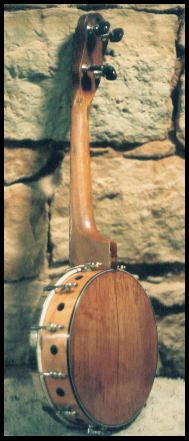
Banjo in a Bag
One afternoon one of the guys from Music Mart called and said…“Uh, TJ,
we got something here for you to look at.” When I arrived at the store I was
handed a plastic bag with THIS thing inside it. He said a lady with Blue Hair
walked in and asked if this could be put back together. It was such a curious
looking pile of wreckage that I agreed…if only to find out what it had once
been!
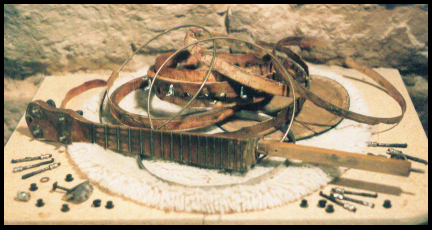
When I called the lady later that day…she informed me that it had once
belonged to a long since deceased relative and that she had remembered him
playing it when she was very young. I’m a chronic sucker for nostalgia…so I got
right to it. And…believe it or not… nearly every single tiny part had been saved
and was used again. I think the only parts I had to add were the strings and the
skin head. It looks as if the poor old thing had spent at least some time under
water and then baked in an attic for several decades. It’s a Banjo/Ukulele… and
they were pretty common around the turn of the (last) century.
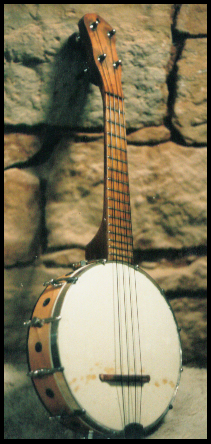
I never met the Lady with the Blue Hair…but later reports indicate that
she was very pleased with the results.
________________________________________
Weird Stuff:
The Mouse Fiddle
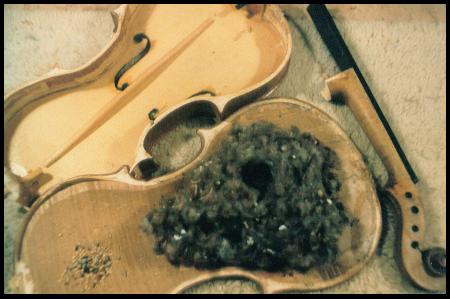
A friend of mine used to play this nice old Violin. It sounded pretty
good but certainly wasn’t a Stradivarius. And its condition and tone did not
improve when he accidentally backed over it with his pick-up truck! He brought
it home to his shack in the country… put it up on a shelf for the rest of the
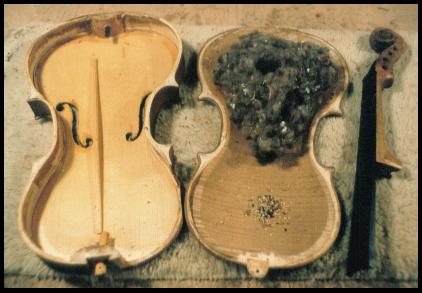
Winter and the next Spring he donated it to me for the parts. When I popped off
the back…there inside was the coziest little Mouse Nest…made of the finest
English Wool…for his old wool sweater had been next to the Violin on the shelf
and this Mouse had made out of it quite possibly the warmest Mouse Nest in all
of Southern Minnesota! You can still see the remains of tiny seeds that were
eaten. Tiny turds and urine are not visible…though quite evident! And despite
the fact that a little bit of the F-hole had been nibbled on…the Violin was
easily repaired. And the following Autumn it’s new owner didn’t mind at all the
ever so slight “Mousy Aroma” that wafted out of the sound holes…for the old
Violin actually sounded better after it had been Run Over and Moused On!
|