|

Herping the Siouxland
Snakes
of the
Minnesota
River Valley
|
Tom Jessen
(TeeJay)
Minnesota Valley Biological Survey
(I now have a new Facebook page
too!)
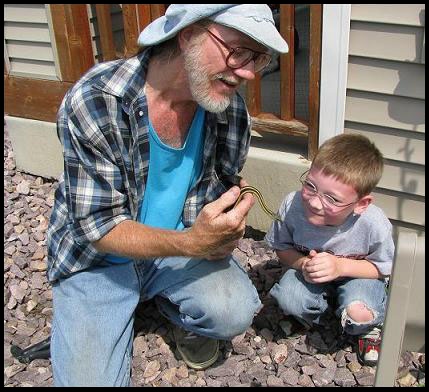
Since I
was 10 years old I’ve had a burning desire to pick up
and examine all sorts of squirming creatures. I was
lucky enough to have been raised up on a farm just a few
miles west of The Blue Mound in SW Minnesota and about
15 miles south of The Pipestone National Monument.
(Both of these places had a tremendous amount of early
childhood influence on me.)
Rock County is famous for its Sioux Quartzite
outcropping. I encountered my first Fox Snake in 1968
on my Uncle Elmer’s farm near Jasper. And despite the
fact that the poor thing had just gone through a baling
machine and was badly mangled…I was still fascinated.
Since then I’ve been bringing home all manner of strange
creatures.
After
graduating from Luverne High School in 1976 I traded
Quartzite for Dolomite when I moved to Mankato. After 20
years of Prairie Grass and Corn…the vast wooded areas of
the Minnesota River Valley and it’s Limestone
Formations seemed like a tropical rain forest and
it has been my beloved new home ever since. Its here I
began my slightly extended (and dubious) career as a
college student.
In June of 1995 I started field research for the
Minnesota DNR. (Dept. of Natural Resources)
In ‘95 and ‘96 I went back out to SW Minn. to
monitor some newly discovered isolated colonies of
Blandings Turtles. From 1997 to 1999 I was part of the
Minnesota County Biological Survey concentrating most of
my time in the Minnesota River Valley.
I spent the next 2 years pounding nails and building
instruments.
From 2002 to 2005 I worked for South Dakota
conducting field surveys for Reptiles and Amphibians of
the eastern counties.
Since 2000, South Dakota has begun to map out its
wildlife and I signed up for the Wildlife
Diversity Program
Small Grants Program.
In 2006 and 2007 I worked, once again, for the
Minnesota County Biological Survey.
From April to October I drive around
(and sometimes live in) my 1990 Chevy Lumina mini-van.
(I took out the seats and made a nice little traveling
field lab and apartment on wheels.)
Since 2008 I've been busy researching a newly discovered
population of Blandings Turtles in south central
Minnesota. That work continues to this day.
Update: The Chevy Lumina has
recently passed away. It was a good ol' horse, and was my
faithful companion for 23
years!
----------------------------------------------------------------------
April/May/June:
The search continues for Blandings Turtles!
(A state threatened species) We are still looking
for reports and sightings of these rare and reclusive
Turtles in the SW and south central counties of
Minnesota. 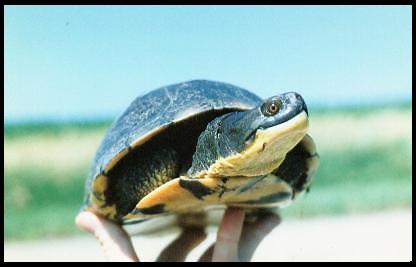 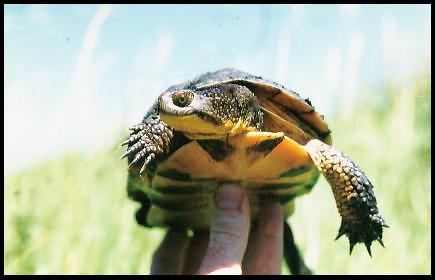
If
you find a Turtle with a bright yellow chin and throat
and it looks like its Smiling at you...PLEASE: Leave
it Alone and DON'T bring it home as a "Pet" !!!
If
you can...take a good close-up photo, let it go on
it's way and contact me. 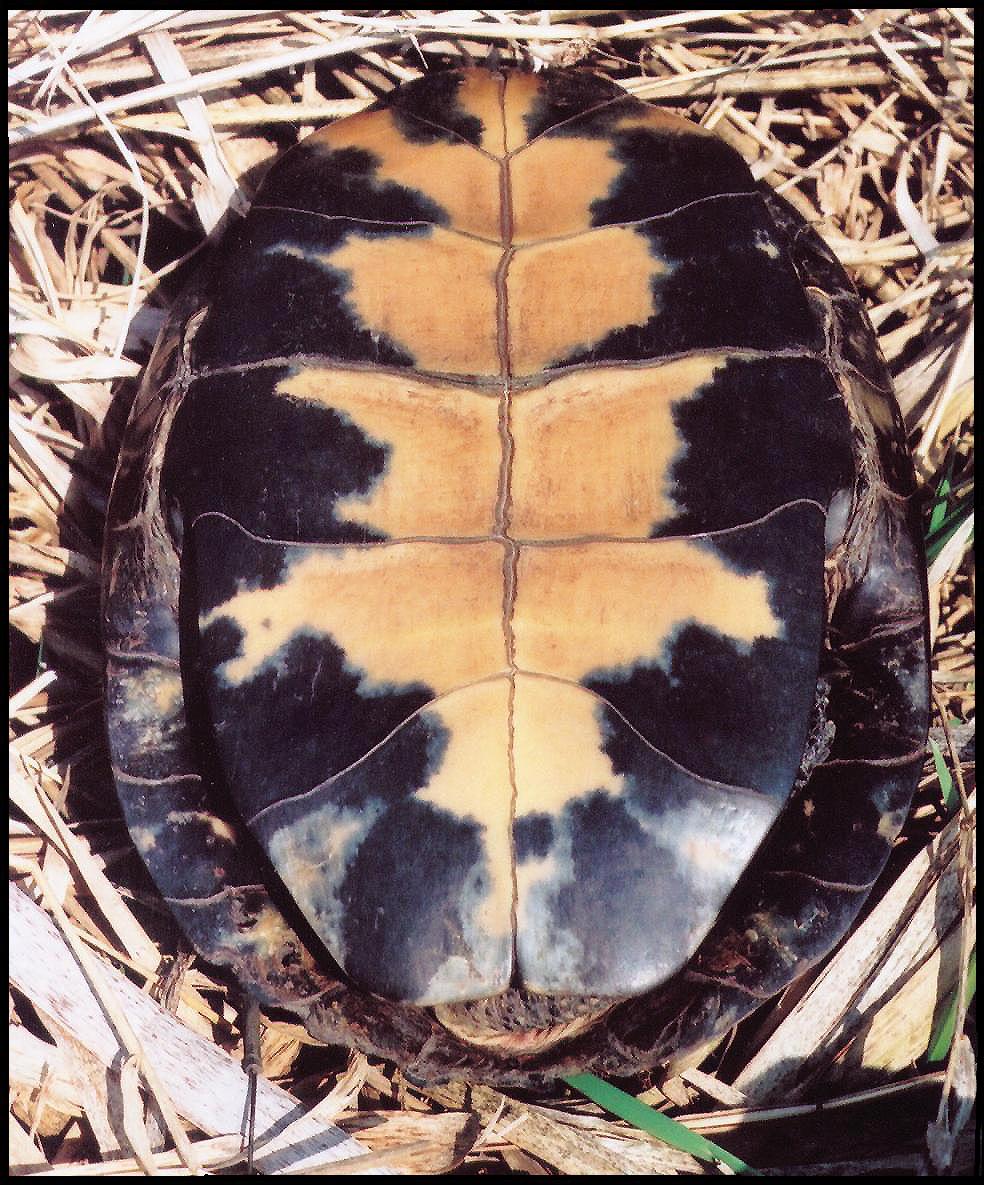
Actually...If
at all possible...try to take as many detailed photos
as you can. (Especially of the chin, throat and belly)
The belly pattern on each Turtle is different (kind of
like a finger-print) and we use these to identify each
individual one.
Part of the Blandings Turtle project involves radio
telemetry.
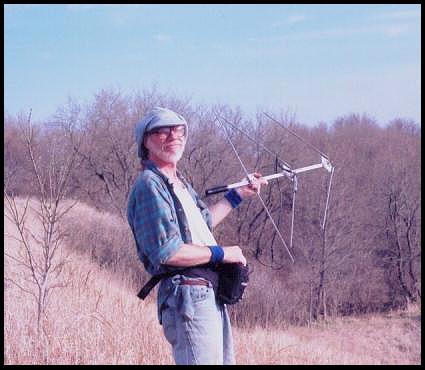
During the month of April, turtles are
captured and a small radio transmitter is attached to
the back of the shell. Each radio emits a beep on a
certain frequency, and as you turn the antenna towards
the radioed turtle, the receiver picks up the signal
and the beep gets louder and louder the closer you
get.
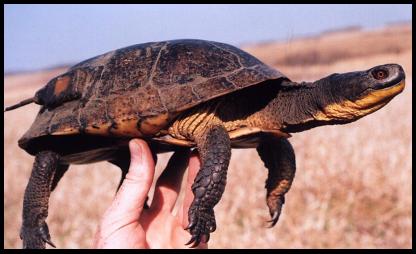
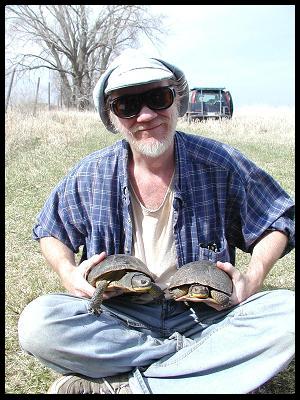
Here
you can see one of the small devices attached to a
Blandings Turtle. They are glued on with a rubber
epoxy and eventually fall off if the battery wears out
and the signal goes dead.
We've already found a lot of really cool and
surprising information on the life habits and
wanderings of these ancient Turtles. The data is still
being entered into the state natural heritage
data-base and more info will be available as soon as
we know more.
_____________________________________
May/June 2008
In the Spring
of 2006, I returned to scanning the wetlands of SW
Minnesota for Amphibians. (After spending the
previous 4 Spring seasons in Eastern South Dakota.)
"Scanning" means driving around from sundown till 2
or 3 in the morning listening for the mating calls
of Frogs and Toads. It was great fun until it got
really expensive. Fortunately, I just finished up
the latest contract with the DNR just at about the
time when gas prices hit $ crazy! Lately I've been
doing a lot of field research from the seat of my
bicycle.
Anyway...There is a
list of "target species" that we concentrate on
looking for. These are the ones that are classified
as somewhere between "not quite so common" to
"critically endangered". For example: Garter Snakes,
Painted Turtles, and Leopard Frogs are still fairly
abundant so I don't stop and take a photo of every
single one of those I find. (I do however, keep
track in my journal, of every single Reptile and
Amphibian and other critters that I encounter)
The Blandings
Turtle, of course, is on this list. And there are
several other kinds of Amphibians that we are
monitoring including these two:
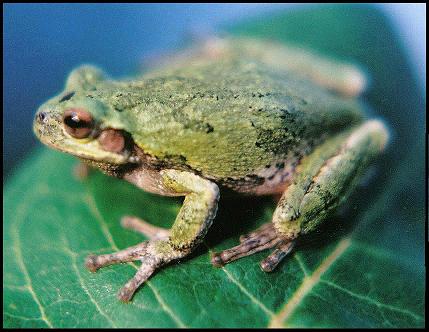
the Gray
Tree Frog
and the Great
Plains Toad 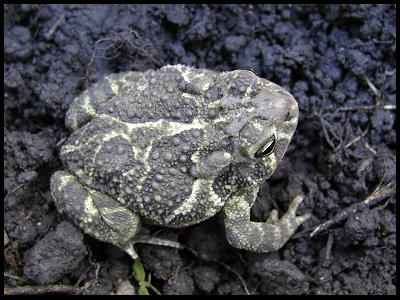
Tree Frogs are small, about an inch and a half long
and can change color from gray to green to match
their surroundings. They are extremely difficult to
see although their call can be heard from quite a
distance, and kind of sounds like a short 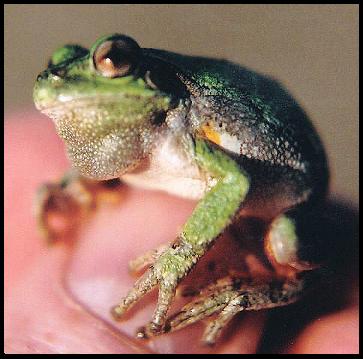 loud
metallic "belch". They live in groves of trees for
most of the year and during the breeding season,
travel (sometimes great distances) to pools of
standing water. Breeding season lasts from early May
through June. Although Tree Frogs will occasionally
call 'just for fun' all the way thru summer on warm
muggy nights. loud
metallic "belch". They live in groves of trees for
most of the year and during the breeding season,
travel (sometimes great distances) to pools of
standing water. Breeding season lasts from early May
through June. Although Tree Frogs will occasionally
call 'just for fun' all the way thru summer on warm
muggy nights.
Tree Frogs seem to
absent from the six SW Minn. counties. They are
abundant in Watonwan, Brown and Martin counties
wherever there are trees and standing water. I have
been gathering evidence since 2006 that Tree Frogs
may be expanding their range farther west. They seem
to be colonizing the corridors along the 3 branches
of the Watonwan River and Elm Creek. 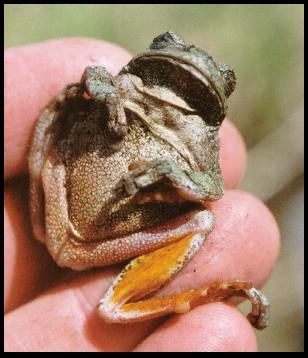 This
past spring I heard them calling in several places
2-3 miles farther west than last year and the year
before. They seem to go only so far, then go silent
even tho there is favorable habitat farther to the
west. (This is a long term project and it is way too
soon to announce these findings officially.) This
has become my own pet project and I am already This
past spring I heard them calling in several places
2-3 miles farther west than last year and the year
before. They seem to go only so far, then go silent
even tho there is favorable habitat farther to the
west. (This is a long term project and it is way too
soon to announce these findings officially.) This
has become my own pet project and I am already 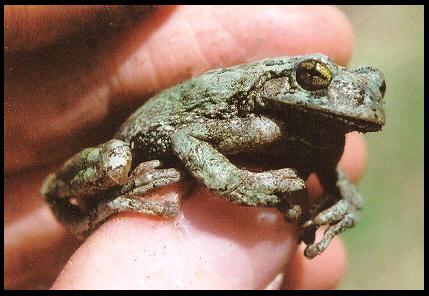 looking forward looking forward
to next
year so I can "pick up the trail" once again. I
absolutely Love these weird little things! It's just
about the closest you can get to actually meeting a
little buggy-eyed space alien!
This past
June, after those heavy rains we had, I heard more
Tree Frogs than ever before, calling from nearly
Every damp portion of the landscape!!! (Flooded
fields, backwater areas along creeks and even
road-side ditches!)
Needless to say...Spring 2008 was Great for
Amphibians!
And those heavy June
rains produced another big surprise: On the evening
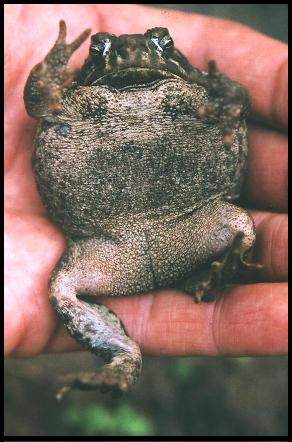
of June 7...Great Plains Toads (Bufo cognatus) were heard calling in
Watonwan county!!! The very first time this species
has ever been documented this far East! 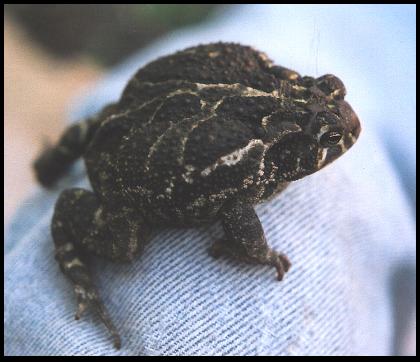
Plains Toads are a little different than our more common
American Toad: They have big dark circular blotches
on their back. (Common Toads are a lot more
speckled) And while American Toads have a nice sweet
sounding "tinkly" kind of trill that lasts from 5-20
seconds at a time...the Plains Toads emit an
ear-shattering metallic jack-hammer like trill that
lasts from 20 seconds to a minute long.
(The sound can be truly deafening at close range!!!)
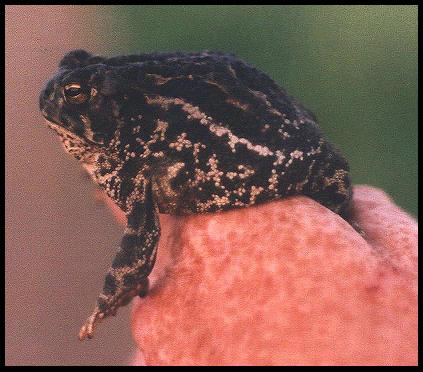
Plains Toads are fairly common in the western states
and, in the past, have been documented in every SW
county in Minnesota. However...During the last 2
years (2006 and 2007) the Minnesota County
Biological Survey failed to find any of them in the
areas where they were previously documented. The
conditions have to be just right for these Toads to
call and reproduce: Intense heavy downpours and
temporary standing pools of water. ('06 and '07 were
Not good years for this) So it was a huge (and
pleasant) surprise when the flooded fields of my own
immediate neighborhood produced not only favorable
conditions...but the Toads that went with it! I have
been scanning this area since 1997 and have Never
heard a Plains Toad around here.
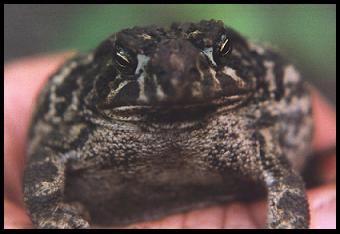
Now all of a sudden
within a space of one week I found at least 18
different locations where Plains Toads were heard
calling! Where they have been hiding all this time
and how they can survive so many long years without
reproducing is still a mystery. And to add to the
puzzle: almost every single one of those flooded
fields completely dried up in just 2 weeks or so.
Not barely enough time for the eggs to hatch, the
tadpoles to 'morph' and for the baby toads to leave
the water. (The tiling and drainage of the cropland
is proving most effective as our society favors Corn
over Toads)
Still...It would
seem that a considerable number of Great Plains
Toads have beaten the odds and are still here among
us. One thing's for sure: I'm gonna be hittin the
brakes and stopping to closely look at Every single
tiny Toad that crosses my path from now on. You just
don't know when the next totally unexpected
surprising thing will pop up next!
--------------------------------------------------------------------------
September:
September is
Salamander month!
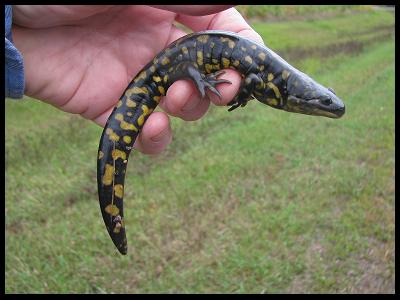
The cool Autumn
rains bring the Salamanders out and this year I am
happy to announce I saw a Lot more than last year!
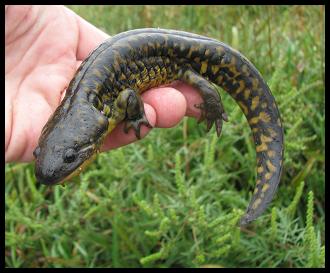
I didn't get much of
a chance to scan as much of Watonwan county as
previous years but instead concentrated around an
area of ponds and wetlands not far from Madelia. 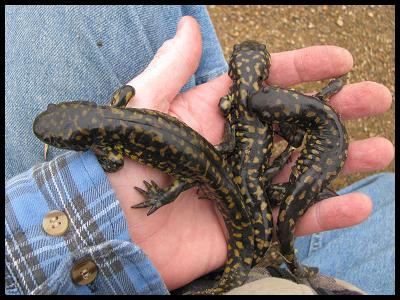
There was one
particular stretch of gravel road where up to 3 at a
time could be seen out walking around! Usually only
one or two were visible at a time...and I made it a
point to stop and look at each and every one. There
seems to be Huge portions of the landscape where
they are simply not seen anymore...but in certain
areas where conditions are favorable...they are
still fairly abundant. And BIG, too! This year I
found 2 of the biggest and most beautifully colored
Tiger SalamandersI've ever seen! 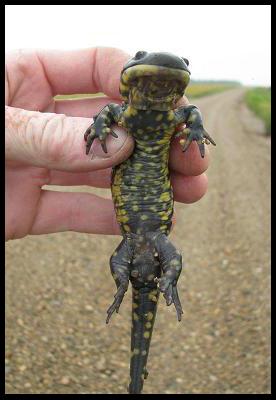
And some of them
even behave and pose nicely for the camera. How can
anyone resist a face like this?
----------------------------------------------------------------------
|