
Western Fox Snake
(Elaphe vulpina)

Fox Snakes have a unique range distribution. They are a northern variety of the Ratsnake family. In fact, there have been suggestions to rename them
Northern Ratsnakes.

I have been conducting research on Fox snakes since I was 10 years old.
_____________________________
I currently have two wild
caught/rescued adults as long term honored
guests in my home. Photos of the adults down below.
_____________________________
The story of how they came to be permanent residents of our household began in 2011, with the installation of some nylon mesh erosion control netting along a bike trail near Mankato, Minnesota.
_____________________________
In May, 2010,
I was horrified to see a new a new bike trail was being
plowed through some prime snake habitat. It came very
close to a rock outcrop hibernacula, but when I saw that
the bike trail was going over only a small portion of
the outcrop, I relaxed a little, and thought the worst
had passed.
All summer,
during its construction, I could see them installing
what appeared to be fairly small strips of nylon mesh
erosion control netting (So I thought) and kept
reminding myself to go take a closer look as soon as the
work was complete. Four days after its grand opening, I
finally got out there to check it out, and was
absolutely stunned to see this:

All
of the silvery gray area in these photos is nylon
mesh netting. On both sides of the trail !!


This
newly exposed bedrock, and hopefully future den
sites in the side of the hill.

However... They covered the entire remaining outcrop with this stuff!

I counted a
total of 9 dead Fox snakes (2 live ones rescued) and
4 dead adult female Garter snakes (With one live one
rescued) The next day I went back and marked the
location of each dead Fox snake with a red flag.

The
old den sites were located along the hiway to the
left. (Photo below) All snakes were found on the
right side of the trail, indicating they were on
their was from the wooded river bottoms to their
hibernation dens.

And now, several ghastly images of
what this stuff can do:


I found two Fox snakes that were still moving.


I
actually had to cut into the skin a couple times to
get them out.


Along with several
lacerations, this one had several broken ribs from
twisting and turning around trying to get loose.

I managed
to save only two adult females. And as they could
barely move upon being freed from the netting, I
decided to bring them home with me. I set them up in a
temporary enclosure and offered them a drink.
As you can see, one of them was so weak and
dehydrated, she didn't even bother to right herself
until she had a good long drink.

As soon as I dipped their chins in to
the water bowl, they both immediately began
drinking and continued non-stop for at least ten
minutes.

Sadly, both of them eventually succumbed to their injuries and died a few weeks later.
_____________________________
The
following spring, I went back out and found two large
adult Fox snakes that had just emerged from their
hibernation den. The nylon mesh netting was still in
place and still a dangerous death trap, so I decided
to bring them home and set up a captive breeding
program.
Keep in
mind... This was in 2011 and the laws have changed
since then.
All
reptiles and amphibians in Minnesota have now been
officially designated as 'State Protected Species' and
can no longer be removed from their natural
environment.
__________________________
For now... I will introduce Rocky:
(The female)

And Bullwinkle: (The male)


Rocky... on the other hand... bit me at least a dozen times on the way home, and as I was setting up her enclosure!
(Since then she has tamed down completely,
just like her new mate)
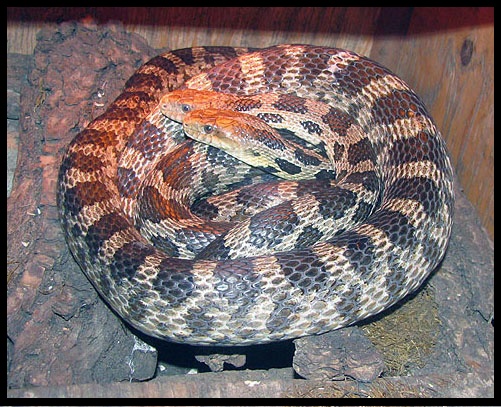
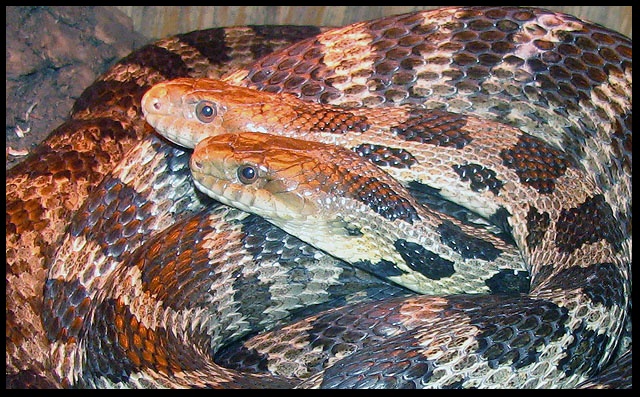
Their heads really aren't that rusty red.
It's a reflection from the red heat bulb.
__________________________
Here's the 4 level Grand Palace they currently live in. All 4 levels are connected and they can crawl from top to bottom.
Arboreal habitat on top, small space between the heat lamps, main level and the lower portion where it's always nice and cool.


The lower portion is where they spend the winter.

_________________________________
Every September I gave a Snake Talk at the Harkin Store, a historical country store site in Nicollet County, from 2011 to 2019.
Bullwinkle
was always a big hit with the kids!


_________________________________
By the end of October they are ready for a long winter's nap, and they both crawl down into the lower chambers of the big enclosure. They will stay down there until April, at a steady temp of about 54 degrees with about 40% humidity.
They seem to prefer to be cool and dry curled up on the bare rocks, but there is a big water bowl and a layer of moss to keep them from getting too dry and dehydrated.

_________________________________
And here's the life history of
Western Fox snakes:
_________________________________
Western Fox Snake (Elaphe vulpina)
The Fox Snake is a tan and brown spotted snake that
can grow up to 5 feet long. They emerge from
hibernation during the last week of April. The month
of May is the breeding season.
On Memorial Day weekend I had the opportunity to
witness (and photograph) some rarely seen courtship
and breeding behavior. These photos were taken with a
Pentax K1000 35mm camera. Remember...These snakes are
all completely wild. (No tame pet actors here.)  However...most of them were so intent
with courtship and breeding that very few exhibited
aggressive behavior. Only one thing on their tiny
little minds:
Reproduction!
However...most of them were so intent
with courtship and breeding that very few exhibited
aggressive behavior. Only one thing on their tiny
little minds:
Reproduction!
This photo gives you an idea of how big these are.
This one measured about 3 and 1/2 feet. Each snake was
caught, measured, photographed and released
again. Most of them stayed around the immediate area and some of them were re-captured several times.

When 2
males meet they size each other up. 
If
they are an even match and neither one backs down...
the fight begins. 
It can get a bit rough and one of them gets in a good bite! I didn't even see this when I took the photo.

The confrontation usually involves a wrestling match
as one tries to pin the other one's head to the
ground. 
They spin
around and around like 2 ropes in a Tornado! 
It gets
pretty tight and nasty towards the end. Below
you can see one of them gets in another bite. That did it! The loser crawled away
and the winner gave a brief chase until he was out of
sight. A few minutes after the fight ended a female
came crawling into view. He picked up her scent on the
ground and began following close behind.
That did it! The loser crawled away
and the winner gave a brief chase until he was out of
sight. A few minutes after the fight ended a female
came crawling into view. He picked up her scent on the
ground and began following close behind.

The lighter colored male was totally oblivious to me as I frantically snapped the photos. The female was an unusually dark colored specimen. She had just emerged from a nearby pond and was still pretty slow and cool to the touch. This was to his advantage ...as I recorded the ground temperature at 103 degrees! He was all warmed up and ready to go.


 Sometimes the mating process is just as
rough as the male dominance battle. When the male
reaches the female's neck he bites her too! If she's
ready to mate she stops crawling and the male begins
to wrap his tail around hers.
Sometimes the mating process is just as
rough as the male dominance battle. When the male
reaches the female's neck he bites her too! If she's
ready to mate she stops crawling and the male begins
to wrap his tail around hers.
The chase and capture took place right out in the open
on a hot sunny day.  But soon after
he had retained his new mate...he gradually guided her
into the shade of a small clump of weeds nearby. There
they proceeded to mate. They remained together for
about a half hour and paid no attention to me at all.
I've seen all of this before in captive
specimens... but have never before witnessed
this in the wild. (I do have even more detailed
and graphic pics of the actual mating but I
think we'll stop it here for now.
But soon after
he had retained his new mate...he gradually guided her
into the shade of a small clump of weeds nearby. There
they proceeded to mate. They remained together for
about a half hour and paid no attention to me at all.
I've seen all of this before in captive
specimens... but have never before witnessed
this in the wild. (I do have even more detailed
and graphic pics of the actual mating but I
think we'll stop it here for now.
___________________________________________
About a month later during the last week of June
(usually around the Summer Solstice) pregnant females
can be found crawling across roads and trails looking
for a safe place to lay their eggs. In 1994 I found
several females out moving around just before sundown
and decided to bring one home. (I already had a nice
place all set up for her so I could photograph the
procedure)
*Please
note: You should NEVER bring home a wild
animal of Any kind unless you have done extensive
research first and can provide it with adequate
care...even if it's only a temporary captive!!!
During the 4th of July weekend she began the nesting
procedure. The photos down below show a female in the
process of "building" a nest. In the wild they lay
their eggs under a hollow log or large flat
rock...anywhere the eggs can be warm and moist and
safe from predators such as Raccoons and Skunks. 
She began by digging out an area in
the moist soil under a small hollow log. (I removed
the log when she started for better viewing and to
take the photos) She didn't seem to mind and kept rig ht on digging) She's
actually turning round and around hollowing out a
small depression in the soil. She did this for 10
minutes until she had it just right.
ht on digging) She's
actually turning round and around hollowing out a
small depression in the soil. She did this for 10
minutes until she had it just right.
Then the
actual egg laying began.  The eggs come out of the vent near the base of her
tail. Each one is over an inch long and is soft and
flexible like a marshmallow.
The eggs come out of the vent near the base of her
tail. Each one is over an inch long and is soft and
flexible like a marshmallow.  Here comes egg # 3.
An egg is laid about every 20 minutes. At the bottom
of this photo you can just barely see the snake's
head. It
Here comes egg # 3.
An egg is laid about every 20 minutes. At the bottom
of this photo you can just barely see the snake's
head. It  appears as if
she becomes unconscious just before egg-laying begins.
Her head drops down to her side and does not move
through-out the process. I've noticed this in
other
appears as if
she becomes unconscious just before egg-laying begins.
Her head drops down to her side and does not move
through-out the process. I've noticed this in
other  species too. No
eye movement or tongue flicking occurs during the
several hours it takes to lay about a dozen eggs at a
time. This female produced 14 eggs. Shortly after the
last one was laid...she appeared to regain
consciousness and eventually left the eggs to hatch
all by themselves.
species too. No
eye movement or tongue flicking occurs during the
several hours it takes to lay about a dozen eggs at a
time. This female produced 14 eggs. Shortly after the
last one was laid...she appeared to regain
consciousness and eventually left the eggs to hatch
all by themselves.
I  removed them from the big
observation cage and put them in a container filled
with mulch from an old rotten log. Here you can see
the set-up I had to view and photograph the show.
Towards the end of August the eggs begin to hatch.
These were kept at room temperature.
removed them from the big
observation cage and put them in a container filled
with mulch from an old rotten log. Here you can see
the set-up I had to view and photograph the show.
Towards the end of August the eggs begin to hatch.
These were kept at room temperature. 
(Which in
My little one-room non air-conditioned apartment was
about 85 degrees) The baby snake makes a slit in the
soft eggshell with a tiny "egg-tooth" on the tip of
it's nose. This looks like a tiny grain of salt and
soon falls off after the baby emerges. You can see the
sliced up egg-shells to the left. The little snakes
literally knife their way out of the egg! (These were
hatched out in a 10 gallon aquarium with a nice
"Autumn Scene" taped to the back. All  these hatchlings are piled
up under the light soaking up the heat. The momma
snake was released at the spot where I found her
shortly after she laid her eggs. And soon after these
photos were taken...all of these little ones were
released in the same general area where the female was
found, too. Young Fox Snakes are about a foot long,
eat small mice and can be found from about late August
right on up to the first blizzard of the Winter! They
spend the winter underground down below the frost
line.
these hatchlings are piled
up under the light soaking up the heat. The momma
snake was released at the spot where I found her
shortly after she laid her eggs. And soon after these
photos were taken...all of these little ones were
released in the same general area where the female was
found, too. Young Fox Snakes are about a foot long,
eat small mice and can be found from about late August
right on up to the first blizzard of the Winter! They
spend the winter underground down below the frost
line.
Adults will climb up into low trees and bushes and eat hatchling birds and fledglings they can catch on the ground... but they are mostly great consumers of Mice, Rats and Gophers and should be considered a friend of the farmer and gardener!
___________________________________
I am no longer
offering captive hatched
juveniles for sale.
All captive hatched
snakes are now
photographed and released in
isolated
areas of the Minnesota River
Valley.

An average of a dozen eggs are
laid around the 4th of July.

A Tupperware container is
filled up half way with Perlite, then soaked in water.

The eggs
are placed on the moist Perlite and a digital
thermometer is inserted midway into the clutch.

The rest
of the container is filled with dry Perlite with a
layer of moss over them.
The moss is then sprayed with water and the cover
securely attached.

The
containers are then placed in an area with a steady 83
degrees.


After about 2 months they begin to hatch. Sometimes over night and very quickly!


They stay in these until they are ready to be released.


